
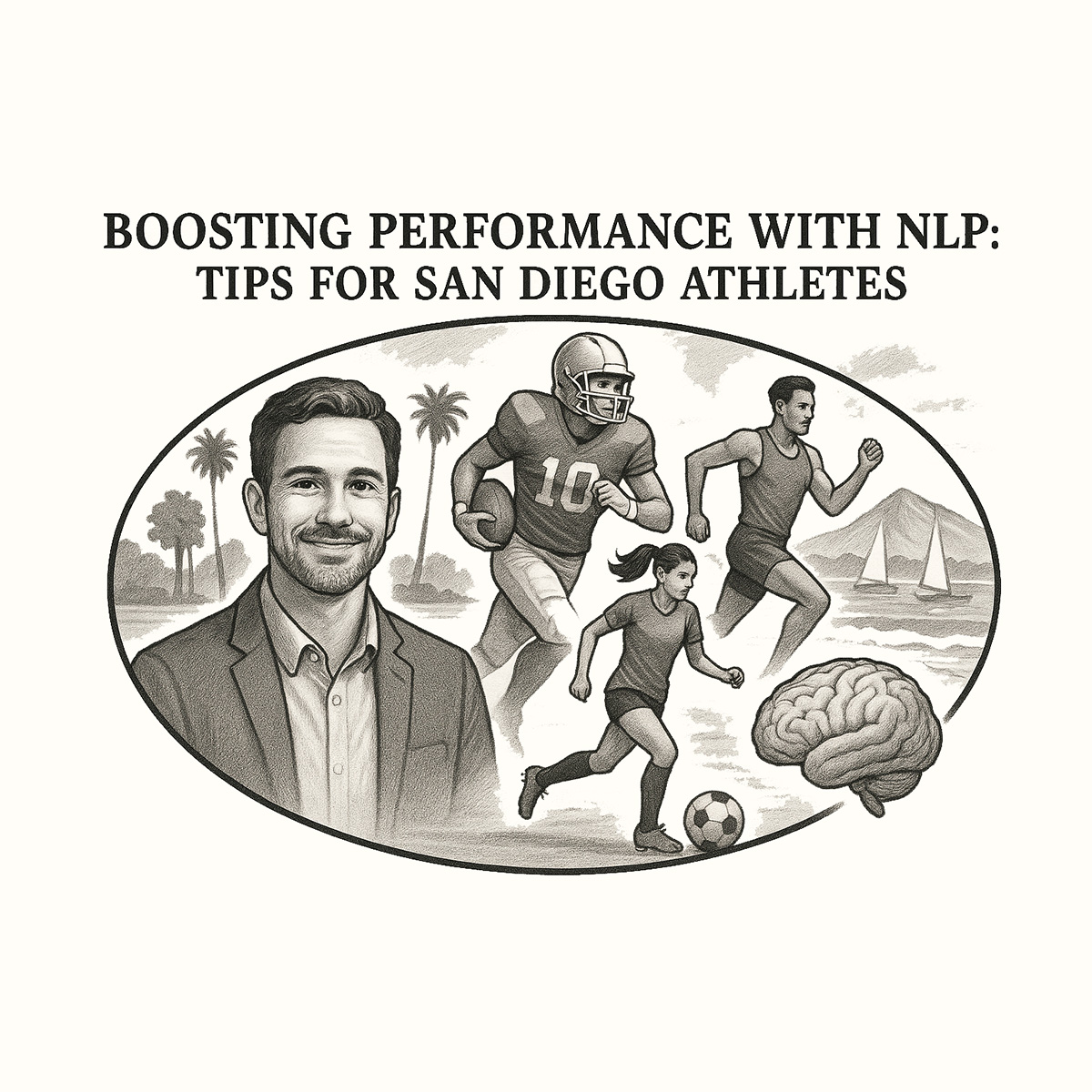
Boosting Performance with NLP: Tips for San Diego Athletes
As a Sports Performance Consultant and Licensed Marriage and Family Therapist based in San Diego, I’ve had the privilege of working with countless athletes, from high school standouts honing their skills on local fields to collegiate competitors pushing their limits at institutions like San Diego State University (SDSU) and the University of California San Diego (UCSD). San Diego’s dynamic sports scene, with its year-round perfect weather, coastal training spots like Mission Beach and Torrey Pines, and a thriving community of young athletes, provides an ideal backdrop for peak performance. But what separates good athletes from great ones often isn’t just physical training—it’s the mental game.
Enter Neuro-Linguistic Programming (NLP), a powerful psychological approach that focuses on the connection between neurological processes, language, and behavioral patterns learned through experience. NLP San Diego athletes are increasingly turning to these techniques to enhance focus, build resilience, and achieve breakthroughs. Developed in the 1970s by Richard Bandler and John Grinder, NLP draws from fields like hypnosis, therapy, and modeling successful behaviors to reprogram the mind for success. In sports, it’s about optimizing how you think, communicate with yourself, and visualize outcomes.
In this post, I’ll share practical NLP tips tailored for San Diego athletes, whether you’re a high school soccer player at Cathedral Catholic or a collegiate swimmer at UCSD. These strategies, drawn from my years of experience as a Certified Dharma Life Coach and Sports Performance Consultant, can help you overcome mental blocks, boost confidence, and elevate your game. Let’s dive in.
Understanding NLP and Its Role in Athletic Performance
Before we get to the tips, let’s break down why NLP is such a game-changer for athletes in San Diego. Our city boasts a rich high school and collegiate sports landscape: SDSU’s Aztecs dominate in basketball and football, drawing crowds to Snapdragon Stadium; UCSD’s Tritons excel in water polo and track, leveraging the region’s ocean proximity for training; and high schools like La Jolla High and Helix Charter produce top-tier talent in everything from volleyball to cross-country. But amid the competition, mental hurdles like performance anxiety, self-doubt, or inconsistent focus can derail even the most talented players.
NLP addresses these by reframing how your brain processes experiences. It’s not about “positive thinking” alone—it’s a structured set of tools to align your thoughts, emotions, and actions. Research and case studies, such as those from sports psychology journals, show that NLP techniques can improve mental skills and performance under pressure. For instance, a study on young shooters using NLP reported enhanced focus and results in competitive scenarios. As a San Diego-based consultant, I integrate NLP into my sessions to help athletes tap into their inner resources, much like how local pros use the city’s sunny trails for physical conditioning.
NLP works by modeling excellence: We study what top performers do mentally and replicate it. Whether you’re prepping for the CIF San Diego Section championships or aiming for NCAA glory, these techniques can give you an edge. Now, let’s explore five key NLP strategies with step-by-step guidance.
Tip 1: Anchoring for Instant Confidence Boosts
One of the most accessible NLP techniques is anchoring—creating a physical or mental trigger that instantly recalls a peak emotional state. Think of it as a mental shortcut to your best self. For San Diego athletes, who often train in high-stakes environments like the annual Holiday Bowl or local track meets at Balboa Stadium, anchoring can combat pre-game jitters.
Here’s how it works: Recall a time when you performed at your absolute best—maybe that flawless swim meet at UCSD’s Canyonview Aquatic Center or a winning goal in a high school rivalry game against Mater Dei Catholic. Close your eyes, vividly relive the sights, sounds, and feelings: the crowd’s roar, the adrenaline rush, the sense of invincibility. As the emotion peaks, perform a simple anchor, like pressing your thumb and forefinger together or saying a keyword like “power.”
Practice this daily. Before your next practice at Petco Park’s youth clinics or a collegiate scrimmage at SDSU, activate the anchor to summon that confidence. In my San Diego practice, I’ve seen high school basketball players use anchoring to improve free-throw accuracy by 20-30%, simply by associating the gesture with past successes. Start small: Anchor during warm-ups, then build to competitions. This NLP San Diego tip is especially useful in our fast-paced sports culture, where mental recovery from setbacks—like a tough loss to a rival team—is crucial.
Tip 2: Visualization and Future Pacing for Mental Rehearsal
Visualization, or mental imagery, is a cornerstone of NLP that’s backed by sports science. Athletes like Olympic swimmers and golfers use it to “pre-experience” success, and it’s particularly effective for San Diego’s water-based sports enthusiasts, from surfers at La Jolla Shores to collegiate rowers on Mission Bay.
In NLP terms, this is future pacing: Projecting yourself into a successful future outcome. Begin by finding a quiet spot—perhaps overlooking the Pacific during a jog along the Embarcadero. Sit comfortably, breathe deeply, and visualize your performance in vivid detail. See yourself executing a perfect dive at the SDSU Aztec Aquaplex or crossing the finish line first in the San Diego Half Marathon. Engage all senses: Feel the water’s resistance, hear your coach’s encouragement, taste the sweat, smell the ocean air.
To amplify it, use submodalities—NLP’s way of tweaking mental images. Make the visualization brighter, larger, and more colorful for positive outcomes; dim and shrink negative scenarios. Practice for 10-15 minutes daily. Studies, including those on NLP in shooting sports, show this boosts performance by enhancing neural pathways, much like physical reps. As a Sports Performance Consultant in San Diego, I guide athletes through customized visualizations, helping high school track stars shave seconds off their times by mentally rehearsing races at local venues like the San Diego Invitational.
Tip 3: Reframing Negative Self-Talk for Resilience
Negative self-talk can sabotage even the strongest athletes, turning a missed shot into a spiral of doubt. NLP’s reframing technique flips this by changing the perspective on events, much like how San Diego’s resilient sports community bounces back from defeats—think the Aztecs’ comebacks in March Madness.
Reframing involves questioning limiting beliefs with the Meta Model, a set of linguistic patterns to uncover distortions. For example, if you think, “I always choke under pressure,” reframe it to, “In past games, I felt pressure, but I’ve succeeded before—what can I learn?” This shifts from generalization to specificity.
For San Diego athletes, apply this during high-pressure moments, like CIF playoffs or collegiate conference tournaments. Journal post-practice: Identify negative thoughts, then reframe them positively. “That error was a disaster” becomes “That error was a learning opportunity to refine my technique.” In my Kensington office near La Jolla, I’ve used reframing with collegiate baseball players to transform fear of failure into excitement for growth, leading to better batting averages. This NLP San Diego strategy builds mental toughness, essential in our competitive high school leagues where teams like Torrey Pines High vie for state titles.
Tip 4: Modeling Excellence from Local Heroes
NLP emphasizes modeling, studying and replicating the strategies of successful people. In San Diego’s sports scene, you have plenty of icons: Padres stars like Manny Machado for baseball precision or SDSU alumni like Kawhi Leonard for basketball mindset.
To model, observe or research a role model’s behaviors. Watch videos of UCSD Tritons’ championship runs or interview coaches at local high schools. Break it down: What do they visualize? How do they handle stress? Adopt their self-talk or routines. For instance, model a pro surfer’s balance by mimicking their pre-wave mental prep.
Incorporate this into training: During sessions at the San Diego Sports Arena or beach workouts, role-play as your model. Over time, integrate their traits. NLP research highlights modeling’s role in accelerating skill acquisition, as seen in athletes using it for peak states. As your San Diego consultant, I facilitate modeling exercises, helping young athletes emulate local legends to fast-track their development.
Tip 5: Dissociation for Overcoming Setbacks
Finally, dissociation helps athletes detach from emotional pain, viewing setbacks objectively. For San Diego’s high-stakes sports, like high school football rivalries or collegiate soccer derbies, this prevents rumination.
Imagine floating above yourself during a tough moment, like a fumbled play. Observe without emotion: “What happened? What can I adjust?” This NLP technique, often combined with anchoring, reduces anxiety. Practice by reviewing game footage dissociated, then reassociate with positive reframes.
Clients in my San Diego practice report faster recovery from injuries or losses, staying competitive in leagues like the Avocado League.
How NLP Coaching with John Boesky Can Elevate Your Game
As a dedicated Sports Performance Consultant in San Diego, I blend NLP with my expertise in therapy and coaching to create personalized plans. With over 20 years of experience, including facilitating men’s groups and working with diverse athletes, I offer empathetic, insight-driven sessions; either in-person at my Kensington office or virtually via Zoom.
Whether you’re a high school athlete navigating college recruitment or a collegiate player aiming for pros, NLP can unlock your potential. My approach emphasizes compassion and practical tools, helping you thrive in San Diego’s vibrant sports community.
Ready to boost your performance with NLP? Contact me today to schedule a consultation. Call (619) 280-8099 or use the contact form on my website to see if we’re a good fit. Let’s turn your athletic dreams into reality; right here in San Diego.